Thursday, May 19, 2011

Japanese Menu - Yakitori

Menu Taste and Personal Experience:

Hmm what can I say about this dish, so many things actually. Just imagine the succulent chicken thigh marinated and basted with the sweet and savory sauce, combine it with fresh spring onion, grill them in piping hot charcoal ... ahh.. so heavenly!!
Whenever I went to a Japanese restaurant, I will almost certainly tried their yakitori. Even though I did experience some bad tasting yakitori like undercooked meat, really salty sauce, etc. But if you manage to taste the good ones, you won't stop thinking about it, just like me :)

Menu Description:

Japanese Menu Yakitori
Yakitori is a type of Japanese skewered chicken. The term Yakitori can also refer to skewered food in general. Kushiyaki (skewer grilled), is a formal term that encompasses both poultry and non-poultry items, skewered and grilled. Both Yakitori and Kushiyaki mean the same, so the terms are used interchangeably in Japanese society.

Yakitori is made from several bite-sized pieces of meat (usually chicken) and vegetables skewered on a bamboo skewer and grilled, usually over charcoal.

Diners ordering yakitori usually have a choice of having it cooked with salt (shio) or with tare sauce, which is generally made up of mirin, sake, soy sauce and sugar. The sauce is applied to the skewered meat and is grilled until delicately cooked. According to urban legend, there are chefs who refuse to clean the pot. In theory, they just add new ingredients every day to the same pot and never throw away the old sauce. It is said that some chefs have been using the same pot since the establishment of the restaurant. By doing that, the sauce is supposed to become more concentrated.

Yakitori is the perfect culinary match for beer. If that alone doesn't convince you that yakitori is delightfully in all regards, the bear in mind that it's an inherently fun food
Japanese Menu Yakitori
In the 1950's (post war era), the spread of chicken broilers which were brought by the US occupation helped cut the cost of chicken meat. This helped yakitori to gain its popularity in Japan.
Nowadays, Yakitori is widely loved for its delicious taste and low price. Some restaurants are seeking to differentiate themselves from others by using the region's specially bred chicken, such as “Coochin”, “Shamo”, and “Hinaidori”.


Common Poultry Dishes

* hatsu or kokoro, chicken heart
* rebā, liver
* sunagimo, or zuri, chicken gizzard
* tsukune, chicken meatballs
* kawa, chicken skin, grilled until crispy
* tebasaki, chicken wing
* bonjiri, chicken tail
* shiro, chicken small intestines
* nankotsu, chicken cartilage
* toriniku, all white meat on skewer

Japanese Menu Yakitori ChefCommon non-poultry dishes

* ikada (lit. raft), Japanese scallion, with two skewers to prevent rotation
* gyūtan, ox tongue, sliced thinly
* atsuage tōfu, deep-fried tofu
* enoki maki, enoki mushrooms wrapped in slices of  pork
* pīman, green pepper
* asuparabēkon, asparagus wrapped in bacon
* butabara, pork belly
* ninniku, garlic


Menu Ingredients:
(Makes 4 – 6 Yakitori)

• Chicken thigh fillets (1kg), cut into 2.5 cm cubes
• Spring onions/Leeks, cut into 2.5 cm lengths (can also be changed to other vegetables to your liking, eg: cherry tomato or paprika)
• Bamboo skewers

Yakitori sauce (makes 2 cups)

• 6 table spoons sake
• 3/4 cup dark soy sauce
• 1 tablespoon grated fresh ginger root
• 1 clove garlic, crushed
• 3 table spoons Morita Mirin Seasoning
• 2 table spoons sugar
• ½ table spoons of chicken stock (powder)

Menu Directions:

• Soak skewers in cold water for 15 minutes. Drain.
• Meanwhile, combine all Yakitori Sauce (refer above) ingredients in a small saucepan over medium-high heat. Bring to the boil. Reduce heat to medium. Simmer for 5 minutes or until sauce has reduced and thickened slightly. Allow to cool completely.
• Thread chicken and onions onto skewers. Place onto a plate. Brush with sauce.
• Grill skewers over charcoal (recommended because it gives yakitori its unique scent and taste) while basting them with sauce, for 6 to 8 minutes or until cooked through. Can be served with rice.

Menu Related Videos:

How to make Yakitori: 


Yakitori Vendor: 


Yakitori bar: 


Menu Sources and References:

Monday, April 11, 2011

Japanese Menu - SUSHI

Menu Taste and Personal Experience:

Japanese menu sushi boat
Sushi Boat
Who did not know sushi these days? This popular Japanese food has been known world wide for its beauty, variety and delicacy. The taste varies and it really depends on its fillings or toppings. I have tried making this menu a couple of times and I really enjoy making it : ). Nowadays, most of the sushi restaurants/bars that I have come across are equipped with sushi trains/sushi boats where prepared sushi are being placed on a plate and they circle around the tracks/waterways. These tracks/waterways usually located past counter seats and/or tables. Billings are done based on the color/shape/pattern of the plate.

Menu Description:

History

The traditional form of sushi is fermented fish and rice, preserved with salt in a process that has been traced to Southeast Asia, where it remains popular today. The term sushi comes from an archaic grammatical form no longer used in other contexts; literally, "sushi" means "it's sour", a reflection of its historic fermented roots.
Japanese menu sushi platter
Sushi Platter
The vinegar produced from fermenting rice breaks down the fish proteins into amino acids. This results in one of the five basic tastes, called umami in Japanese. The oldest form of sushi in Japan, narezushi, still very closely resembles this process. In Japan, narezushi evolved into oshizushi and ultimately Edomae nigirizushi, which is what the world today knows as "sushi".
Contemporary Japanese sushi has little resemblance to the traditional lacto-fermented rice dish. Originally, when the fermented fish was taken out of the rice, only the fish was consumed and the fermented rice was discarded. The strong-tasting and smelling funazushi, a kind of narezushi made near Lake Biwa in Japan, resembles the traditional fermented dish. Beginning in the Muromachi period (AD 1336–1573) of Japan, vinegar was added to the mixture for better taste and preservation. The vinegar accentuated the rice's sourness and was known to increase its shelf life, allowing the fermentation process to be shortened and eventually abandoned. In the following centuries, sushi in Osaka evolved into oshi-zushi. The seafood and rice were pressed using wooden (usually bamboo) molds. By the mid 18th century, this form of sushi had reached Edo (contemporary Tokyo).
The contemporary version, internationally known as "sushi", was created by Hanaya Yohei (1799–1858) at the end of the Edo period in Edo. The sushi invented by Hanaya was an early form of fast food that was not fermented (therefore prepared quickly) and could be eaten with one's hands at a roadside or in a theatre. Originally, this sushi was known as Edomae zushi because it used freshly caught fish in the Edo-mae (Edo Bay or Tokyo Bay). Though the fish used in modern sushi no longer usually comes from Tokyo Bay, it is still formally known as Edomae nigirizushi.

Nigirizushi

Japanese menu nigiri sushi
Nigiri Sushi
Nigirizushi (hand-formed sushi) consists of an oblong mound of sushi rice that the chef presses into a small rectangular box between the palms of the hands, usually with a bit of wasabi, and a topping draped over it.


Japanese Menu Gunkanmaki
Gunkanmaki
Photo by Phu Son Nguyen
Sushiday.com
Gunkanmaki (warship roll) is a special type of nigirizushi: an oval, hand-formed clump of sushi rice that has a strip of "nori" wrapped around its perimeter to form a vessel that is filled with some soft, loose or fine-chopped ingredient that requires the confinement of nori such as roe, natto, oysters, sea urchin, corn with mayonnaise, and quail eggs.Gunkan-maki was invented at the Ginza Kyubey restaurant in 1931; its invention significantly expanded the repertoire of soft toppings used in sushi.


Japanese Menu Temari Sushi
Temari Sushi
Photo by whatsonxiamen.com
Temarizushi (ball sushi) is a ball-shaped sushi made by pressing rice and fish into a ball-shaped form by hand using a plastic wrap. They are quite easy to make and thus a good starting point for beginners.


Makizushi
Japanese menu maki sushi
Maki Sushi
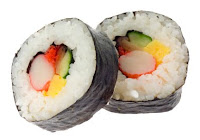
Makizushi (rolled sushi), Norimaki (Nori roll) or makimono (variety of rolls) is a cylindrical piece, formed with the help of a bamboo mat, called a makisu. Makizushi is generally wrapped in nori, but can occasionally be found wrapped in a thin omelette, soy paper, cucumber, or parsley.


Japanese Menu Futomaki
Futomaki
Photo by dineouthere.com
Futomaki (thick, large or fat rolls) is a large cylindrical piece, with nori on the outside. A typical futomaki is three or four centimeters (1.5 in) in diameter. They are often made with two or three fillings that are chosen for their complementary tastes and colors.


Japanese Menu Hosomaki
Hosomaki
Hosomaki (thin rolls) is a small cylindrical piece, with the nori on the outside. A typical hosomaki has a diameter of about two centimeters (0.75 in). They generally contain only one filling, often tuna, cucumber, kanpyō, thinly sliced carrots, or, more recently, avocado.


Japanese Menu Temaki
Temaki
Temaki (hand rolls) is a large cone-shaped piece of nori on the outside and the ingredients spilling out the wide end. A typical temaki is about ten centimeters (4 in) long, and is eaten with fingers because it is too awkward to pick it up with chopsticks. For optimal taste and texture, Temaki must be eaten quickly after being made because the nori cone soon absorbs moisture from the filling and loses its crispness and becomes somewhat difficult to bite.


Uramaki (inside-out rolls) is a medium-sized cylindrical piece, with two or more fillings. Uramaki differs from other makimono because the rice is on the outside and the nori inside. The filling is in the center surrounded by nori, then a layer of rice, and an outer coating of some other ingredients such as roe or toasted sesame seeds.


Oshizushi

Oshizushi (pressed sushi), is a pressed sushi from the Kansai Region, a favourite and specialty of Osaka. A block-shaped piece formed using a wooden mold, called an oshibako. The chef lines the bottom of the oshibako with the toppings, covers them with sushi rice, and then presses the lid of the mold down to create a compact, rectilinear block. The block is removed from the mold and then cut into bite-sized pieces.
Inarizushi

Inarizushi

Japanese Menu Inari Sushi
Inari Sushi
Inarizushi is a pouch of fried tofu filled with usually just sushi rice. It is named after the Shinto god Inari, who is believed to have a fondness for fried tofu. The pouch is normally fashioned as deep-fried tofu (abura age).


Chirashizushi

Japanese Menu Chirasi Sushi
Chirasi Sushi
Chirashizushi (scattered sushi) is a bowl of sushi rice topped with a variety of sashimi and garnishes (also refers to barazushi). Edomae chirashizushi (Edo-style scattered sushi) is an uncooked ingredient that is arranged artfully on top of the sushi rice in a bowl. Gomokuzushi (Kansai-style sushi) are cooked or uncooked ingredients mixed in the body of rice in a bowl. It is eaten annually on Hinamatsuri in March.


Narezushi

Japanese Menu Nare Sushi
Nare Sushi
Narezushi (matured sushi) is a traditional form of fermented sushi. Skinned and gutted fish are stuffed with salt, placed in a wooden barrel, doused with salt again, then weighed down with a heavy tsukemonoishi (pickling stone). As days pass, water seeps out and is removed. After six months this funazushi can be eaten, remaining edible for another six months or more.


Western-style sushi
Japanese Menu California Roll
Western Style Sushi

The increasing popularity of sushi around the world has resulted in variations typically found in North America and Europe, but rarely in Japan. Such creations to suit the Western palate were initially fueled by the invention of the California roll. A wide variety of popular rolls has evolved since.


Condiments
Sushi is commonly eaten with condiments. Sushi may be dipped in shōyu, soy sauce, and may be flavored with wasabi, a piquant paste made from the grated root of the Wasabia japonica plant. However, some consider the use of condiments with sushi to be rude, as it implies that the chef's original preparation was inadequate.
Japanese Menu Gari
Gari - Japanese Pickled Ginger
True wasabi has anti-microbial properties and may reduce the risk of food poisoning. The traditional grating tool for wasabi is a sharkskin grater or samegawa oroshi. An imitation wasabi (seiyo-wasabi), made from horseradish, mustard powder and green dye is common. It is found at lower-end kaiten zushi restaurants, in bento box sushi and at most restaurants outside of Japan. If manufactured in Japan, it may be labelled "Japanese Horseradish".
Gari, sweet, pickled ginger is eaten with sushi to both cleanse the palate and aid in digestion. In Japan, green tea (ocha) is invariably served together with sushi. Better sushi restaurants often use a distinctive premium tea known as mecha. In sushi vocabulary, green tea is known as agari.


Sushi Rice Recipe

Menu Ingredients:

3 cups uncooked sushi or sticky or plain rice
3 cups water
½ cup rice/white/brown vinegar
½ cup sugar
1 teaspoon salt

Menu Directions:

1. Wash the rice and rinse thoroughly.
Japanese Menu Sushi
Sushi
2. Place rice and water in a rice cooker and set until cooked. Alternately, place rice and water in a medium saucepan. Bring to a boil over high heat, reduce to a simmer, and cook covered until done, 35 to 45 minutes.
3. Meanwhile, mix together the rice vinegar, sugar and salt in a small saucepan; cook over medium heat until sugar has dissolved. Allow to cool.
4. Put the cooked rice into a large mixing bowl; pour the vinegar sauce over the hot rice and mix. Allow to cool slightly before using in sushi recipes.

For other sushi recipes, please have a look at the sushi section of Japanese Menu.

Menu Related Videos:


How to make Japanese Menu Temaki Sushi


Sushi restaurant at Tokyo


Tokyo sushi train


Sushi Boat


Menu Sources and References:

Wednesday, February 16, 2011

Japanese Menu - OKONOMIYAKI


Menu Taste and Personal Experience:


Japanese menu Okonomiyaki
One of my in laws friend is a japanese and she made one for us. She made the kansai/osaka style snack menu okonomiyaki where she mix all the ingredients. It tastes very yummy with differenct flavours of sweet, a little bit sour, savory, and salty. Whats more she even put different kinds of fillings like prawns, chicken, beef, etc which makes things more interesting.

Menu Description:


Okonomiyaki is a Japanese snack menu for savoury pancake containing a variety of ingredients. The name is derived from the word okonomi, meaning "what you like" or "what you want", and yaki meaning "grilled" or "cooked" (cf. yakitori and yakisoba). Okonomiyaki is mainly associated with Kansai or Hiroshima areas of Japan, but is widely available throughout the country. The menu's toppings and batters tend to vary according to region.

Kansai area

Osaka-style okonomiyaki is the predominant version of the dish, found throughout most of Japan. The batter is made of flour, grated yam, water or dashi, eggs and shredded cabbage, and usually contains other ingredients such as green onion, meat (generally pork or bacon), octopus, squid, shrimp, vegetables, kimchi, mochi or cheese. Okonomiyaki is sometimes compared to an omelette or a pancake and may be referred to as "a Japanese pancake" or even "Osaka soul food."
Most okonomiyaki restaurants are grill-it-yourself establishments, where the server produces a bowl of raw ingredients that the customer mixes and grills at tables fitted with teppan, or special hotplates. They may also have a diner-style counter where the cook prepares the dish in front of the customers.

In Osaka (the largest city in the Kansai region), where this dish is said to have originated, this Japanese snack menu is pretty much prepared like a pancake. The batter and other ingredients are fried on both sides on either a teppan or a pan using metal spatulas that are later used to slice the dish when it has finished cooking. Cooked okonomiyaki is topped with ingredients that include otafuku/okonomiyaki sauce (similar to Worcestershire sauce but thicker and sweeter), aonori (seaweed flakes), katsuobushi (bonito flakes), Japanese mayonnaise, and pickled ginger (beni shoga).

Hiroshima area

A lantern beckons customers into an okonomiyaki restaurant

In Hiroshima, the ingredients are layered rather than mixed together. The layers are typically batter, cabbage, pork, and optional items such as squid, octopus, and cheese. Noodles (yakisoba, udon) are also used as a topping with fried egg and a generous amount of okonomiyaki sauce.

The amount of cabbage used is usually three to four times the amount used in the more common Osaka style. It starts out piled very high and is pushed down as the cabbage cooks. The order of the layers may vary slightly depending on the chef's style and preference, and ingredients vary depending on the preference of the customer. People from Hiroshima claim that this is the correct way to make okonomiyaki. This style is also called Hiroshima-yaki or Hiroshima-okonomi.

Okonomi-mura, in Naka-ku in Hiroshima, was the top food theme park destination for families in Japan according to an April 2004 poll.
Other areas

In Tokyo, Tsukishima town is popular for both Okonomiyaki and Monjayaki. Monjayaki is a liquid, runny variant of okonomiyaki. The main street of this town is called Monja Street.

In Hamamatsu, takuan (pickled daikon) is mixed in okonomiyaki.

In Okinawa, okonomiyaki is called hirayachi (ヒラヤーチー) and is thinner than ins other areas. People cook it at home, so there are no hirayachi restaurants in Okinawa,[citation needed] although okonomiyaki restaurants can be found in a few places.


Osaka-style Okonomiyaki Recipe

Menu Ingredients:

  • 2 cup all purpose flour
  • 1 1/4 cup dashi soup stock or water
  • 4-6 eggs
  • 1 - 1 1/4 lb cabbage
  • 6 tbsps chopped green onion
  • 2/3 cup tenkasu (tempura flakes)
  • 12 - 18 strips of thinly sliced pork or beef
  • For toppings:
  • Ao-nori (green seaweed)
  • Katsuobushi (bonito flakes)
  • Okonomiyaki sauce (or tonkatsu sauce)
  • Mayonnaise

Menu Directions:


Japanese Menu Okonomiyaki
People Eating Okonomiyaki
Photo by http://www.nnanime.com
Pout dashi soup stock in a bowl. Mix the flour in the soup stock. Rest the batter for an hour in the refrigerator. Chop cabbage finely. Take about 1/2 cup of the batter (to make one sheet of okonimiyaki) in another bowl. Mix chopped cabbage (about 1/4 lb), chopped green onion (about 1 tbsp), and tempura flakes (about 2 tbsps) in the batter. Make a hole in the middle of the batter and add an egg in the hole. Stir the batter. Heat an electric pan and oil slightly. Pour the batter over the pan and make a round. Fry meat or your choice of toppings on the side. Cook 5-7 minutes and place meat (toppings) on top of the okonomiyaki. Flip the okonomiyaki and cook for 5-7 more minutes. Flip the okonomiyaki again and spread okonomiyaki sauce and mayonnaise on top. Sprinkle aonori over the sauce. Sprinkle katsuobushi (bonito flakes) and beni-shoga (red ginger) if you would like. Makes 4-6 sheets.

Hiroshima-style Okonomiyaki Recipe

Menu Ingredients:

  • 1 cup all purpose flour
  • 3/4 cup dashi soup or water
  • 4 eggs
  • 2 cups finely chopped cabbage
  • 2 cups bean sprouts
  • 12 pieces thinly sliced pork
  • 4 packages pre-steamed chucka noodles for yakisoba
  • Seasonings:
  • yakisoba sauce or salt
  • okonomiyaki sauce or Worcestershire sauce
  • Toppings:
  • chopped green onion
  • aonori (dried seaweed powder) 

how to make Hiroshima style Japanese menu Okonomiyaki

Menu Directions:

Mix flour and dashi soup stock to make okonomiyaki batter. Heat and oil a large skillet or iron plate. Spread a scoop of the batter into a thin round over the pan. Place a handful of cabbage and bean sprouts on top of the batter. Place pork slices on top of the vegetables. Pour some okonomiyaki batter over the ingredients. Flip the okonomiyaki over with spatulas. Cook it on low heat until meats and vegetables are cooked. Meanwhile, fry yakisoba noodles on the side and lightly season with okonomiyaki sauce or salt as you like. Replace okonomiyaki with spatulas on top of yakisoba noodles and press on the top firmly. Fry an egg on the side an break the egg york with spatula. Replace the okonomiyaki on top of the fried egg and again press on the top firmly. Serve the okonomiyaki on a plate with the egg side up. Repeat this process to make more okonomiyaki. Spread okonomiyaki sauce or Worcestershire sauce and mayonnaise on the okonomiyaki. Sprinkle chopped green onion and ao-nori (dried seaweed powder) on the top.
*Makes 4 servings 

Menu Related Videos:


Hiroshima Style Okonomiyaki Vendor


Hiroshima Style Okonomiyaki


Osaka Style Okonomiyaki


How To Make Snack Menu - Okonomiyaki


Menu Sources and References:

Sunday, January 16, 2011

My First Japanese Menu is TAKOYAKI.

Menu Taste and Personal Experience:


I love this snack menu. Basically they taste sweet, a little bit sour, savory, and salty with crispy batter skin and chewy fillings (octopus). In conclusion, they are very delicious and tasty. People also sell takoyaki with different fillings, eg: Sliced beef sausage/ham, sliced chicken sausage, vegetarian fillings, cheese, etc.

Menu Description:


japanese menu takoyakiTakoyaki (literally fried or grilled octopus) is a popular Japanese dumpling made of batter, diced or whole baby octopus, tempura scraps (tenkasu), pickled ginger, and green onion, topped with okonomiyaki sauce, ponzu, mayonnaise, green laver (aonori), and katsuobushi (fish shavings).

History:

It was first popularized in Osaka where a street vendor named Endo Tomekichi is credited with its invention in 1935. Takoyaki can be found in shops called issen-yoshokuwhich roughly translates to "one-penny Western food". Yaki is derived from "yaku" which simply means "to fry or grill" in Japanese, and can be found in the names of other Japanese cuisine items such as teriyaki or sukiyaki.


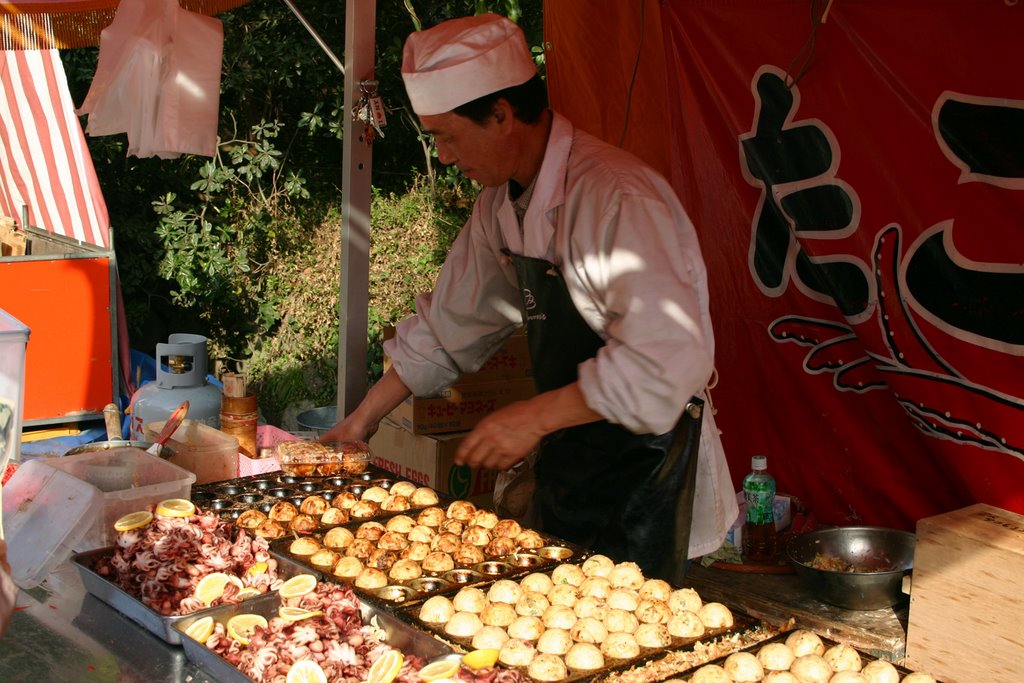
Takoyaki Street vendor

Menu Ingredients:


Batter

  • 100 gram flour
  • 1 egg
  • 400 ml water 
  • 1/4 tbsp kombu dashi (bonito/fish stock)
  • 1/4 tbsp soy sauce 

Fillings

  • Half Boiled octopus - cut into 1cm square (other fillings can be used like prawns, beef sausages, etc)
  • Bread Crumbs (Optional)
  • Cheddar Cheese - cut into 1/2cm square (Optional)
  • Gari (Pickled Japanese Ginger) - chopped (Optional)
  • Chopped spring onion (scallions) (Optional)
Toppings
  • Nori (dried seaweed) - chopped or powder
  • Katsuobushi (Dried bonito flakes)
  • Japanese Mayonnaise
  • Takoyaki sauce ( or Worcestershire sauce )

Menu Directions:


Takoyaki Pan

  1. Warm up iron plate and oil the surface.
  2. Put the batter into the hole to almost full.
  3. Then put all fillings into the hole.
  4. When batter on the edge of the molds become cooked (the inside batter should still be liquidy), turn over takoyaki with pick.
  5. When batter browns turn over to form balls. Continue to heat while turning it over and over until balls become evenly browned and well cooked inside.
  6. Serve on plate, top with sauce, mayo,  katsuobushi and nori to taste.

Menu Related Videos:


How to make snack menu - takoyaki


Takoyaki Vendor


Automatic Tako Pan for making the menu


Menu Sources and References: