Showing posts with label Snack. Show all posts

Monday, November 7, 2011

Japanese Menu - Yakisoba Pan

Menu Taste and Personal Experience:


I was surfing the internet, looking at various stuff until my eyes caught on something that greatly interest me. It was yakisoba pan!! I thought that it is a really unique kind of food. It’s kinda disappointing that I did not find any stall that sell yakisoba pan while I am holidaying at Japan couple years ago. I went to one of the New Year’s Eve festival but all I could find was yakisoba vendor. So I decided to research about it a bit. I tried cooking it myself several weeks ago. The hardest part was finding the required ingredients, especially the packaged chuka noodle, couldn’t find it anywhere except one store. Anyway making yakisoba pan is really fun, just scroll down to find the ingredients and directions on how to make it.

If we are talking about the taste, the yakisoba itself is sweet, savoury, a wee bit sour and salty. I can just enjoy the yakisoba itself since it taste so good. Now how about the yakisoba pan?? So when I put it inside the hotdog roll, top it with seaweed, katsuobushi and mayonnaise, I give it a bite and my brain was like…. OMG!!! Soo goodddd… really rich in flavour and I can’t even describe it!!! All I can say… YOU GOTTA TRY IT YOURSELF!!! So what are you waiting for, start making it and enjoy :D

Menu Description


Yakisoba, literally "fried noodles", is a dish often sold at festivals in Japan, but originates in China. The dish was derived by the Chinese from the traditional chow mein, but has been more heavily integrated into Japanese cuisine like ramen. Even though soba (noodles made from buckwheat) is part of the word, yakisoba noodles are not made from buckwheat, but are similar to ramen noodles and made from wheat flour.

Yakisoba usually refers to sōsu yakisoba, flavored with yakisoba sauce, a sweetened, thickened variant of Worcestershire sauce.

Yakisoba is most familiarly served on a plate either as a main dish or a side dish. Another popular way to prepare and serve yakisoba in Japan is to pile the noodles into a bun sliced down the middle in the style of a hot dog, and garnish the top with mayonnaise and shreds of pickled ginger. Called yakisoba-pan, pan meaning bread, it is commonly available at local matsuri (Japanese festivals) or konbini (convenience stores).
Sometimes, Japanese white Udon is used as a replacement of Chinese style Soba and called Yakiudon. This variation was started in Kitakyushu in Fukuoka Prefecture.

In Okinawa, Yakisoba is popular with Okinawans and U.S. servicemembers stationed on the island alike. Mess halls and other on-base eateries often serve yakisoba. Ham is a popular addition to yakisoba made in Okinawa, in addition to other meats such as chicken, beef, or pork.


Menu Ingredients:

(makes 2-3 servings)

  • Steamed chuka noodles packaged (~300gr)
  • 3 Tbsp water
  • 200gr pork meat, thinly sliced (chicken or beef or prawn meat can be used)
  • 1 Tbsp mirin
  • 1/2 Tbsp vegetable/olive oil
  • 1/2 Tbsp sugar
  • Salt and pepper to taste
  • 1/4 brown onion, thinly sliced
  • Cabbage, chopped
  • 4-6 Tbsp yakisoba sauce or tonkatsu sauce or worcestershire sauce
  • Beni-shoga (pickled red ginger) thinly sliced
  • Japanese Mayonnaise 
  • Dried seaweed thinly sliced
  • Katsuobushi (bonito flakes)
  • Boiled egg, cut in half (optional)
  • 2-3 Hotdog Roll


Menu Directions:


  1. Loosen packaged noodle and set aside
  2. Heat oil in a pan on medium heat
  3. Stir-fry meat until half cooked
  4. Add salt and pepper to taste
  5. Add onion and stir fry until golden brown
  6. Add cabbage and stir fry for around 1 minute
  7. Stir in noodle, add water and fry for around 2 minute until the noodle are properly loosen and mixed
  8. Add in sauce, sugar and mirin; stir fry until the noodles are evenly coated
  9. Turn off heat and set aside.
  10. Take hotdog bun, open and fill in with yakisoba.
  11. Spread mayonnaise on top of yakisoba, sprinkle with seaweed, katsuobushi (bonito flakes) and benishoga (pickled red ginger). You can also add boiled egg if you like.
  12. Serve


Menu Related Videos:


Making Yakisoba:


Making Yakisoba Pan:


Menu Sources and References:

Thursday, May 19, 2011

Japanese Menu - Yakitori

Menu Taste and Personal Experience:

Hmm what can I say about this dish, so many things actually. Just imagine the succulent chicken thigh marinated and basted with the sweet and savory sauce, combine it with fresh spring onion, grill them in piping hot charcoal ... ahh.. so heavenly!!
Whenever I went to a Japanese restaurant, I will almost certainly tried their yakitori. Even though I did experience some bad tasting yakitori like undercooked meat, really salty sauce, etc. But if you manage to taste the good ones, you won't stop thinking about it, just like me :)

Menu Description:

Japanese Menu Yakitori
Yakitori is a type of Japanese skewered chicken. The term Yakitori can also refer to skewered food in general. Kushiyaki (skewer grilled), is a formal term that encompasses both poultry and non-poultry items, skewered and grilled. Both Yakitori and Kushiyaki mean the same, so the terms are used interchangeably in Japanese society.

Yakitori is made from several bite-sized pieces of meat (usually chicken) and vegetables skewered on a bamboo skewer and grilled, usually over charcoal.

Diners ordering yakitori usually have a choice of having it cooked with salt (shio) or with tare sauce, which is generally made up of mirin, sake, soy sauce and sugar. The sauce is applied to the skewered meat and is grilled until delicately cooked. According to urban legend, there are chefs who refuse to clean the pot. In theory, they just add new ingredients every day to the same pot and never throw away the old sauce. It is said that some chefs have been using the same pot since the establishment of the restaurant. By doing that, the sauce is supposed to become more concentrated.

Yakitori is the perfect culinary match for beer. If that alone doesn't convince you that yakitori is delightfully in all regards, the bear in mind that it's an inherently fun food
Japanese Menu Yakitori
In the 1950's (post war era), the spread of chicken broilers which were brought by the US occupation helped cut the cost of chicken meat. This helped yakitori to gain its popularity in Japan.
Nowadays, Yakitori is widely loved for its delicious taste and low price. Some restaurants are seeking to differentiate themselves from others by using the region's specially bred chicken, such as “Coochin”, “Shamo”, and “Hinaidori”.


Common Poultry Dishes

* hatsu or kokoro, chicken heart
* rebā, liver
* sunagimo, or zuri, chicken gizzard
* tsukune, chicken meatballs
* kawa, chicken skin, grilled until crispy
* tebasaki, chicken wing
* bonjiri, chicken tail
* shiro, chicken small intestines
* nankotsu, chicken cartilage
* toriniku, all white meat on skewer

Japanese Menu Yakitori ChefCommon non-poultry dishes

* ikada (lit. raft), Japanese scallion, with two skewers to prevent rotation
* gyūtan, ox tongue, sliced thinly
* atsuage tōfu, deep-fried tofu
* enoki maki, enoki mushrooms wrapped in slices of  pork
* pīman, green pepper
* asuparabēkon, asparagus wrapped in bacon
* butabara, pork belly
* ninniku, garlic


Menu Ingredients:
(Makes 4 – 6 Yakitori)

• Chicken thigh fillets (1kg), cut into 2.5 cm cubes
• Spring onions/Leeks, cut into 2.5 cm lengths (can also be changed to other vegetables to your liking, eg: cherry tomato or paprika)
• Bamboo skewers

Yakitori sauce (makes 2 cups)

• 6 table spoons sake
• 3/4 cup dark soy sauce
• 1 tablespoon grated fresh ginger root
• 1 clove garlic, crushed
• 3 table spoons Morita Mirin Seasoning
• 2 table spoons sugar
• ½ table spoons of chicken stock (powder)

Menu Directions:

• Soak skewers in cold water for 15 minutes. Drain.
• Meanwhile, combine all Yakitori Sauce (refer above) ingredients in a small saucepan over medium-high heat. Bring to the boil. Reduce heat to medium. Simmer for 5 minutes or until sauce has reduced and thickened slightly. Allow to cool completely.
• Thread chicken and onions onto skewers. Place onto a plate. Brush with sauce.
• Grill skewers over charcoal (recommended because it gives yakitori its unique scent and taste) while basting them with sauce, for 6 to 8 minutes or until cooked through. Can be served with rice.

Menu Related Videos:

How to make Yakitori: 


Yakitori Vendor: 


Yakitori bar: 


Menu Sources and References:

Wednesday, February 16, 2011

Japanese Menu - OKONOMIYAKI


Menu Taste and Personal Experience:


Japanese menu Okonomiyaki
One of my in laws friend is a japanese and she made one for us. She made the kansai/osaka style snack menu okonomiyaki where she mix all the ingredients. It tastes very yummy with differenct flavours of sweet, a little bit sour, savory, and salty. Whats more she even put different kinds of fillings like prawns, chicken, beef, etc which makes things more interesting.

Menu Description:


Okonomiyaki is a Japanese snack menu for savoury pancake containing a variety of ingredients. The name is derived from the word okonomi, meaning "what you like" or "what you want", and yaki meaning "grilled" or "cooked" (cf. yakitori and yakisoba). Okonomiyaki is mainly associated with Kansai or Hiroshima areas of Japan, but is widely available throughout the country. The menu's toppings and batters tend to vary according to region.

Kansai area

Osaka-style okonomiyaki is the predominant version of the dish, found throughout most of Japan. The batter is made of flour, grated yam, water or dashi, eggs and shredded cabbage, and usually contains other ingredients such as green onion, meat (generally pork or bacon), octopus, squid, shrimp, vegetables, kimchi, mochi or cheese. Okonomiyaki is sometimes compared to an omelette or a pancake and may be referred to as "a Japanese pancake" or even "Osaka soul food."
Most okonomiyaki restaurants are grill-it-yourself establishments, where the server produces a bowl of raw ingredients that the customer mixes and grills at tables fitted with teppan, or special hotplates. They may also have a diner-style counter where the cook prepares the dish in front of the customers.

In Osaka (the largest city in the Kansai region), where this dish is said to have originated, this Japanese snack menu is pretty much prepared like a pancake. The batter and other ingredients are fried on both sides on either a teppan or a pan using metal spatulas that are later used to slice the dish when it has finished cooking. Cooked okonomiyaki is topped with ingredients that include otafuku/okonomiyaki sauce (similar to Worcestershire sauce but thicker and sweeter), aonori (seaweed flakes), katsuobushi (bonito flakes), Japanese mayonnaise, and pickled ginger (beni shoga).

Hiroshima area

A lantern beckons customers into an okonomiyaki restaurant

In Hiroshima, the ingredients are layered rather than mixed together. The layers are typically batter, cabbage, pork, and optional items such as squid, octopus, and cheese. Noodles (yakisoba, udon) are also used as a topping with fried egg and a generous amount of okonomiyaki sauce.

The amount of cabbage used is usually three to four times the amount used in the more common Osaka style. It starts out piled very high and is pushed down as the cabbage cooks. The order of the layers may vary slightly depending on the chef's style and preference, and ingredients vary depending on the preference of the customer. People from Hiroshima claim that this is the correct way to make okonomiyaki. This style is also called Hiroshima-yaki or Hiroshima-okonomi.

Okonomi-mura, in Naka-ku in Hiroshima, was the top food theme park destination for families in Japan according to an April 2004 poll.
Other areas

In Tokyo, Tsukishima town is popular for both Okonomiyaki and Monjayaki. Monjayaki is a liquid, runny variant of okonomiyaki. The main street of this town is called Monja Street.

In Hamamatsu, takuan (pickled daikon) is mixed in okonomiyaki.

In Okinawa, okonomiyaki is called hirayachi (ヒラヤーチー) and is thinner than ins other areas. People cook it at home, so there are no hirayachi restaurants in Okinawa,[citation needed] although okonomiyaki restaurants can be found in a few places.


Osaka-style Okonomiyaki Recipe

Menu Ingredients:

  • 2 cup all purpose flour
  • 1 1/4 cup dashi soup stock or water
  • 4-6 eggs
  • 1 - 1 1/4 lb cabbage
  • 6 tbsps chopped green onion
  • 2/3 cup tenkasu (tempura flakes)
  • 12 - 18 strips of thinly sliced pork or beef
  • For toppings:
  • Ao-nori (green seaweed)
  • Katsuobushi (bonito flakes)
  • Okonomiyaki sauce (or tonkatsu sauce)
  • Mayonnaise

Menu Directions:


Japanese Menu Okonomiyaki
People Eating Okonomiyaki
Photo by http://www.nnanime.com
Pout dashi soup stock in a bowl. Mix the flour in the soup stock. Rest the batter for an hour in the refrigerator. Chop cabbage finely. Take about 1/2 cup of the batter (to make one sheet of okonimiyaki) in another bowl. Mix chopped cabbage (about 1/4 lb), chopped green onion (about 1 tbsp), and tempura flakes (about 2 tbsps) in the batter. Make a hole in the middle of the batter and add an egg in the hole. Stir the batter. Heat an electric pan and oil slightly. Pour the batter over the pan and make a round. Fry meat or your choice of toppings on the side. Cook 5-7 minutes and place meat (toppings) on top of the okonomiyaki. Flip the okonomiyaki and cook for 5-7 more minutes. Flip the okonomiyaki again and spread okonomiyaki sauce and mayonnaise on top. Sprinkle aonori over the sauce. Sprinkle katsuobushi (bonito flakes) and beni-shoga (red ginger) if you would like. Makes 4-6 sheets.

Hiroshima-style Okonomiyaki Recipe

Menu Ingredients:

  • 1 cup all purpose flour
  • 3/4 cup dashi soup or water
  • 4 eggs
  • 2 cups finely chopped cabbage
  • 2 cups bean sprouts
  • 12 pieces thinly sliced pork
  • 4 packages pre-steamed chucka noodles for yakisoba
  • Seasonings:
  • yakisoba sauce or salt
  • okonomiyaki sauce or Worcestershire sauce
  • Toppings:
  • chopped green onion
  • aonori (dried seaweed powder) 

how to make Hiroshima style Japanese menu Okonomiyaki

Menu Directions:

Mix flour and dashi soup stock to make okonomiyaki batter. Heat and oil a large skillet or iron plate. Spread a scoop of the batter into a thin round over the pan. Place a handful of cabbage and bean sprouts on top of the batter. Place pork slices on top of the vegetables. Pour some okonomiyaki batter over the ingredients. Flip the okonomiyaki over with spatulas. Cook it on low heat until meats and vegetables are cooked. Meanwhile, fry yakisoba noodles on the side and lightly season with okonomiyaki sauce or salt as you like. Replace okonomiyaki with spatulas on top of yakisoba noodles and press on the top firmly. Fry an egg on the side an break the egg york with spatula. Replace the okonomiyaki on top of the fried egg and again press on the top firmly. Serve the okonomiyaki on a plate with the egg side up. Repeat this process to make more okonomiyaki. Spread okonomiyaki sauce or Worcestershire sauce and mayonnaise on the okonomiyaki. Sprinkle chopped green onion and ao-nori (dried seaweed powder) on the top.
*Makes 4 servings 

Menu Related Videos:


Hiroshima Style Okonomiyaki Vendor


Hiroshima Style Okonomiyaki


Osaka Style Okonomiyaki


How To Make Snack Menu - Okonomiyaki


Menu Sources and References:

Sunday, January 16, 2011

My First Japanese Menu is TAKOYAKI.

Menu Taste and Personal Experience:


I love this snack menu. Basically they taste sweet, a little bit sour, savory, and salty with crispy batter skin and chewy fillings (octopus). In conclusion, they are very delicious and tasty. People also sell takoyaki with different fillings, eg: Sliced beef sausage/ham, sliced chicken sausage, vegetarian fillings, cheese, etc.

Menu Description:


japanese menu takoyakiTakoyaki (literally fried or grilled octopus) is a popular Japanese dumpling made of batter, diced or whole baby octopus, tempura scraps (tenkasu), pickled ginger, and green onion, topped with okonomiyaki sauce, ponzu, mayonnaise, green laver (aonori), and katsuobushi (fish shavings).

History:

It was first popularized in Osaka where a street vendor named Endo Tomekichi is credited with its invention in 1935. Takoyaki can be found in shops called issen-yoshokuwhich roughly translates to "one-penny Western food". Yaki is derived from "yaku" which simply means "to fry or grill" in Japanese, and can be found in the names of other Japanese cuisine items such as teriyaki or sukiyaki.


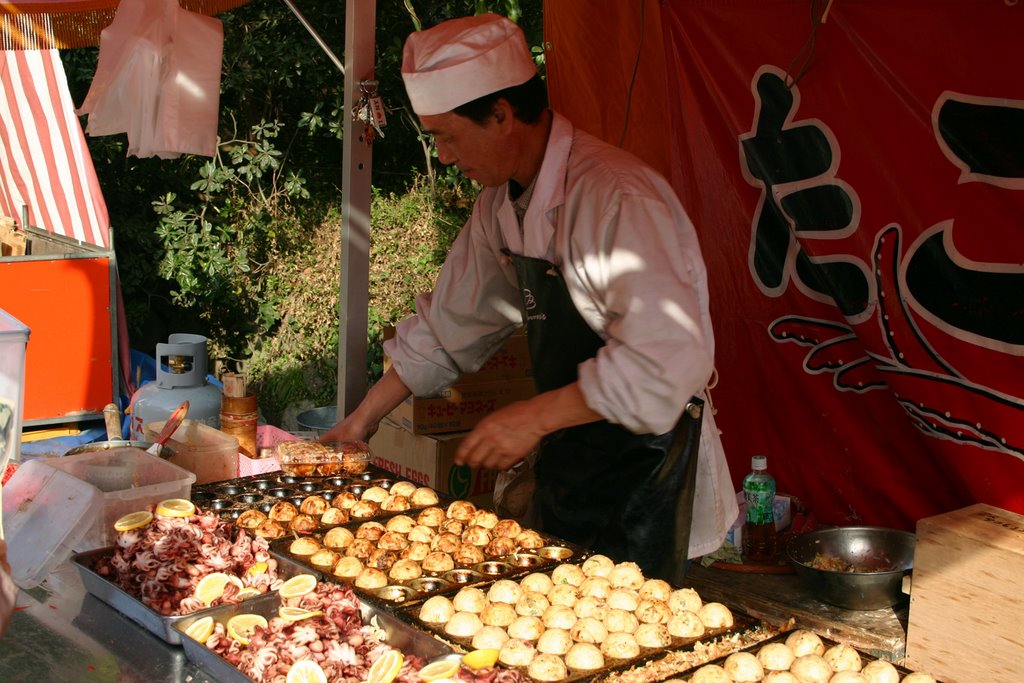
Takoyaki Street vendor

Menu Ingredients:


Batter

  • 100 gram flour
  • 1 egg
  • 400 ml water 
  • 1/4 tbsp kombu dashi (bonito/fish stock)
  • 1/4 tbsp soy sauce 

Fillings

  • Half Boiled octopus - cut into 1cm square (other fillings can be used like prawns, beef sausages, etc)
  • Bread Crumbs (Optional)
  • Cheddar Cheese - cut into 1/2cm square (Optional)
  • Gari (Pickled Japanese Ginger) - chopped (Optional)
  • Chopped spring onion (scallions) (Optional)
Toppings
  • Nori (dried seaweed) - chopped or powder
  • Katsuobushi (Dried bonito flakes)
  • Japanese Mayonnaise
  • Takoyaki sauce ( or Worcestershire sauce )

Menu Directions:


Takoyaki Pan

  1. Warm up iron plate and oil the surface.
  2. Put the batter into the hole to almost full.
  3. Then put all fillings into the hole.
  4. When batter on the edge of the molds become cooked (the inside batter should still be liquidy), turn over takoyaki with pick.
  5. When batter browns turn over to form balls. Continue to heat while turning it over and over until balls become evenly browned and well cooked inside.
  6. Serve on plate, top with sauce, mayo,  katsuobushi and nori to taste.

Menu Related Videos:


How to make snack menu - takoyaki


Takoyaki Vendor


Automatic Tako Pan for making the menu


Menu Sources and References: